Advait Energy Transitions Limited manufactures and supplies OPGW cables for transmission lines across India. Production is carried out through TG Advait India Private Limited at Sanand, Gujarat, where cable diameters of 11.5 mm, 12.0 mm and 12.1 mm hold POWERGRID approval. The facility has completed supply orders for POWERGRID and is approved by GETCO, OPTCL, UPPTCL, MSETCL and the Mizoram board, with project experience at 132 kV, 220 kV, 400 kV and 765 kV.
Request a Quote
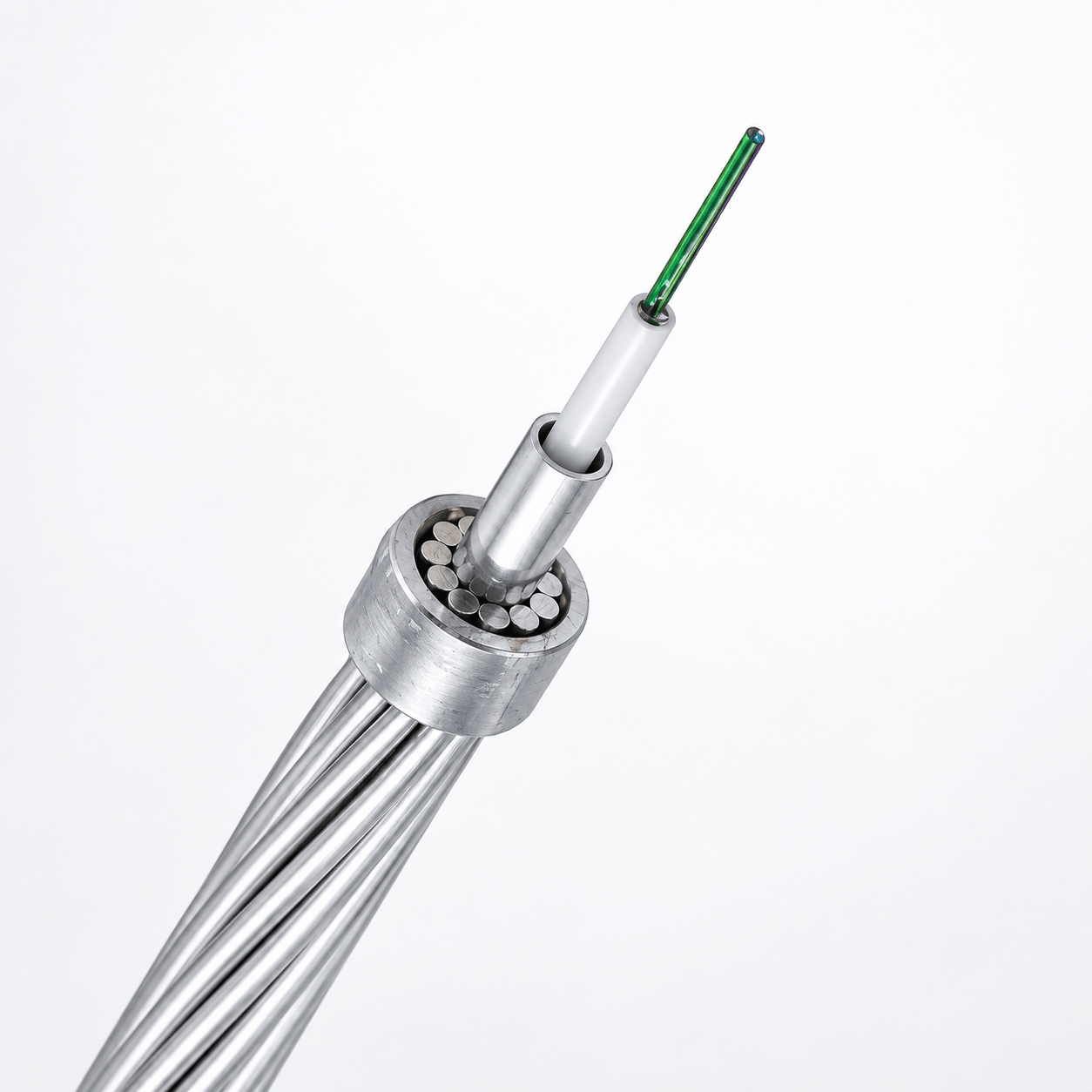
OPGW stands for optical ground wire, also written as optical fibre composite overhead ground wire. It is a cable installed at the earthwire position on the top peak of a transmission tower, and it performs two functions in a single conductor.
Conventional earthwire has occupied that position for more than a century, doing one job: intercepting lightning and carrying fault current to earth. An optical ground wire cable performs that same function while additionally carrying optical fibres for data transmission. One cable, two roles, no second stringing operation along the same route.
An OPGW cable in a transmission line occupies the highest point on the tower, above all phase conductors. That position is what allows it to perform both of its functions.
Lightning seeks the shortest path to earth. Because the OPGW sits above the phase conductors, a strike terminates on it rather than on the conductors carrying power. Fault current is then conducted to earth through the outer metallic layers, which are made of aluminium clad steel wire. The short circuit rating of the cable determines how much fault energy it can absorb without damage to the fibres inside.
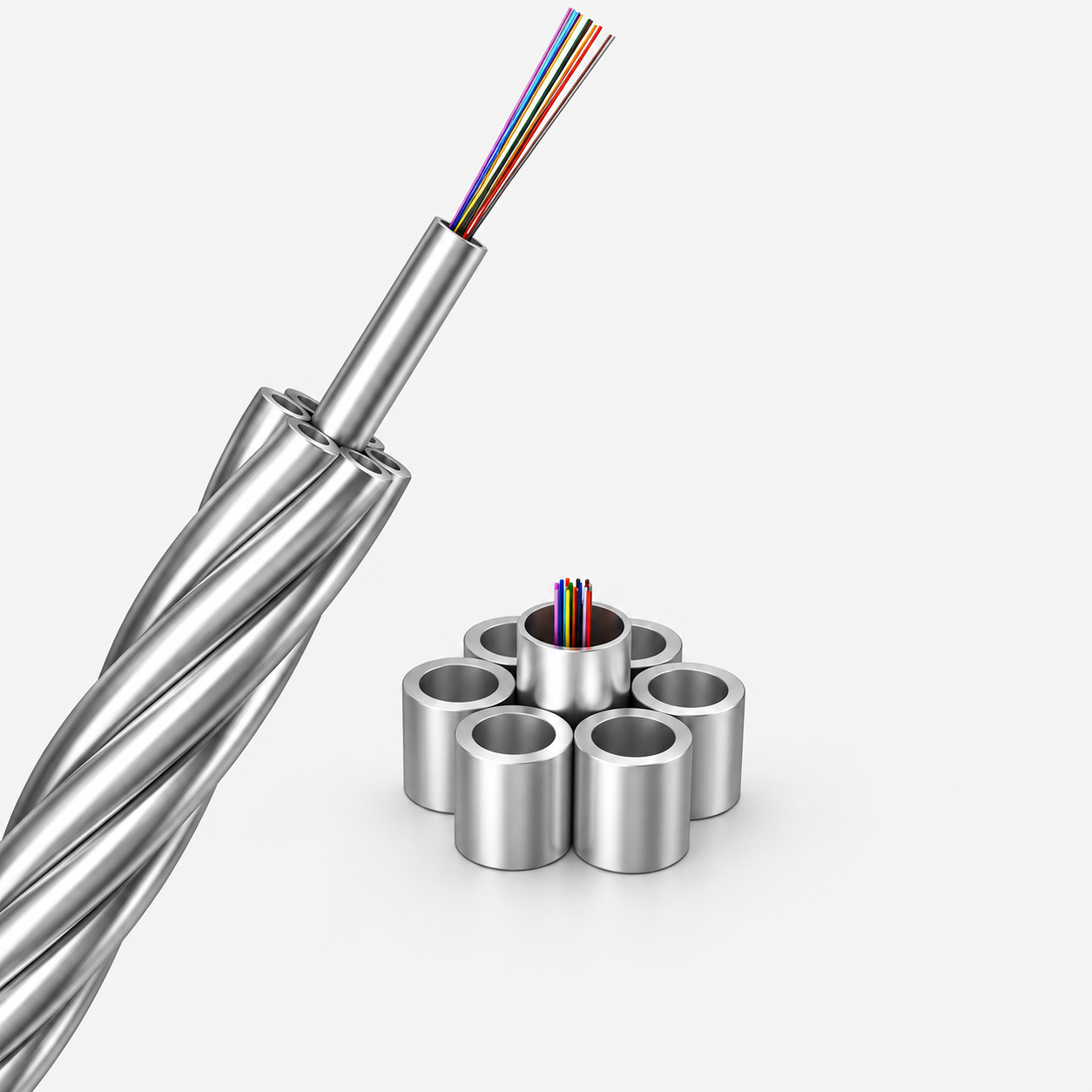
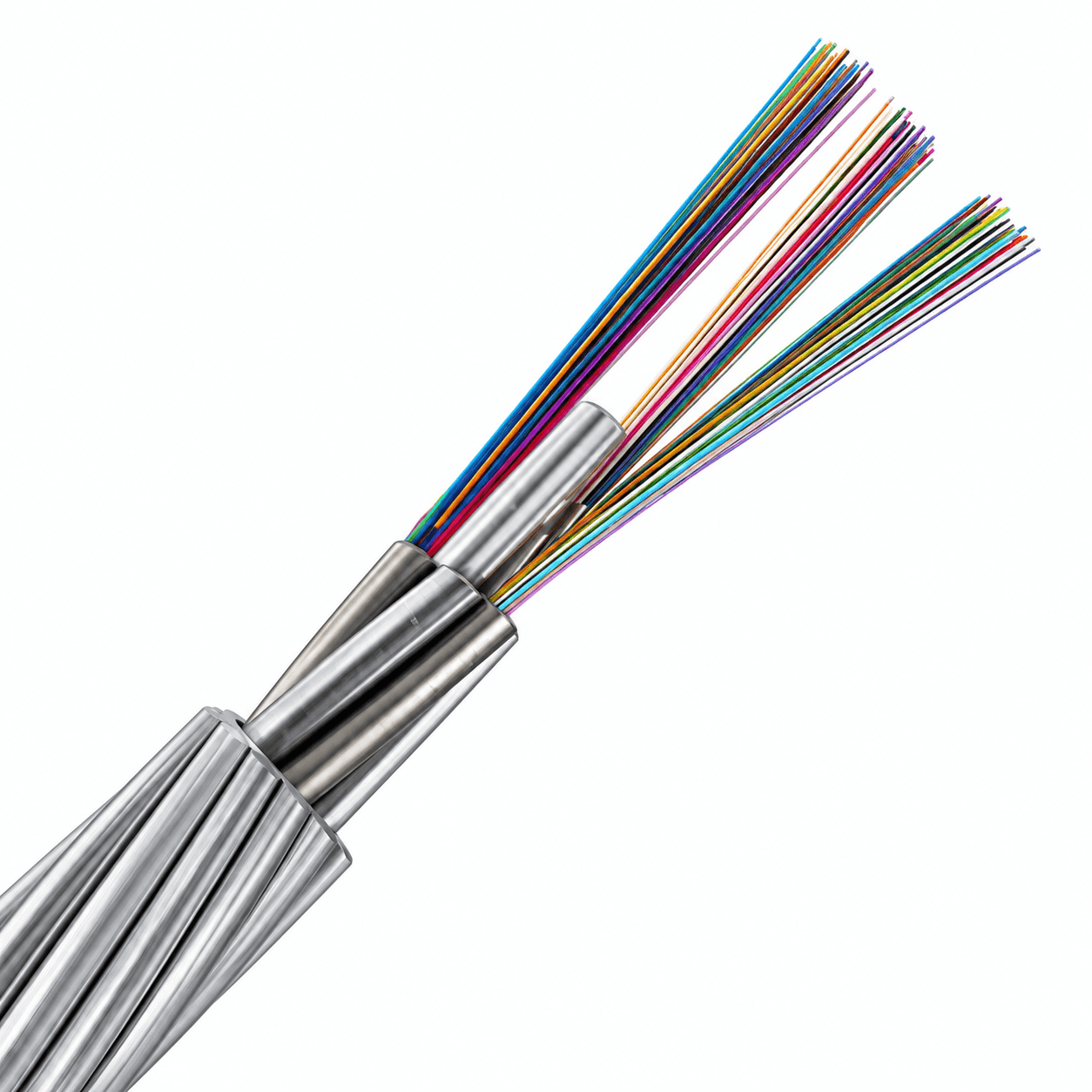
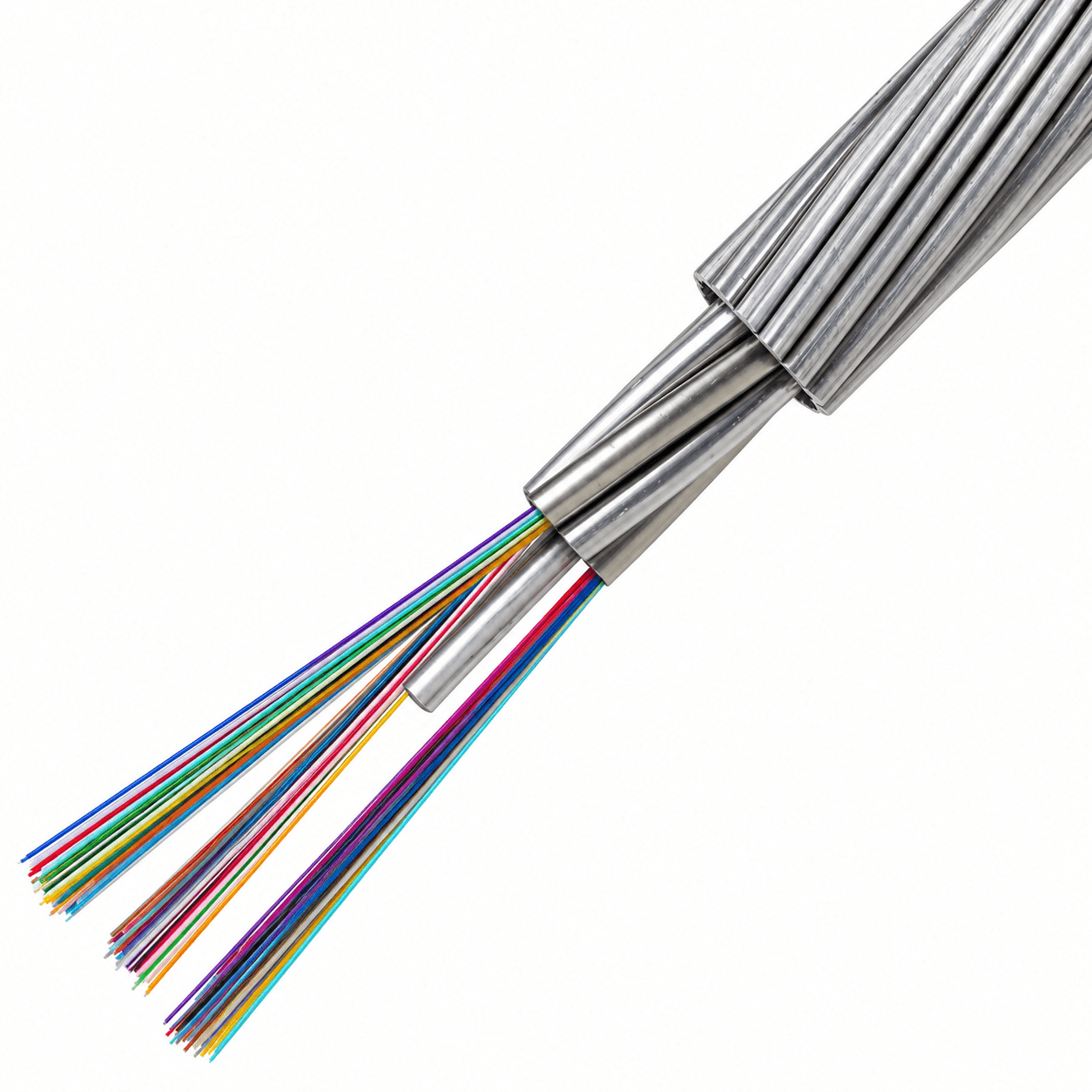
Optical fibres are assembled inside a central tube or across multiple loose tubes within the cable. These carry data along the transmission corridor for SCADA, teleprotection relaying, synchrophasor measurement and grid monitoring. Because the fibres transmit light rather than electric current, high voltage induction from the adjacent conductors has no effect on the signal.
This dual function has become more valuable as the grid has changed. Variable generation from solar and wind requires continuous real-time measurement across the network, and that measurement depends on a communication path running the length of every line.
OPGW is manufactured to the drawing approved for each transmission project. The parameters below are those normally called for in a tender.
| Fibre Count | 24F and 48F standard, other counts to design requirement. |
| Cable Diameter | 11.5 mm, 12.0 mm, 12.1 mm — POWERGRID and state board approved. |
| Tube Construction | Central tube and multi loose tube. |
| Outer Layer | Aluminium clad steel wire. |
| Fibre Type | Single mode G.652D. |
| Voltage Class Experience | 132 kV, 220 kV, 400 kV, 765 kV. |
| Short Circuit Capacity | [CONFIRM: kA²s rating range] |
| Rated Tensile Strength | [CONFIRM: kN range] |
| Standards | IEC 60794, IEEE 1138, customer-approved drawing. |
Fibre count is selected against the utility's present communication requirement and its expected growth, including any capacity it intends to lease to third parties. Cable diameter follows from fibre count, tube construction and the short circuit rating required, and must match a diameter already approved by the purchasing utility.
Short circuit capacity defines the fault energy the cable withstands without thermal damage to the fibres. Rated tensile strength governs sag and tension calculations across each span. Both are set by the transmission line design and should be confirmed before the drawing is approved.
A complete installation requires fittings at every tower position:
| Suspension Clamp | Supports the cable at intermediate towers. |
| Tension Clamp | Terminates the cable at dead-end and angle towers. |
| Vibration Damper | Controls aeolian vibration across the span. |
| Downlead Clamp | Secures the cable down the tower leg to the splice point. |
| Joint Box | Encloses the fibre splice between cable drums. |
Splices are normally made every two to six kilometres, where cable drums are joined. Each splice introduces a small signal loss, so a well-designed route minimises the number required.
Manufacturing is carried out by TG Advait India Private Limited, a joint venture between Advait Energy Transitions Limited and Jiangsu Tongguang Optical Fibre Cable Company. The plant is located at Sanand GIDC, Gujarat, approximately 35 km from Ahmedabad, and was established under the Make in India initiative.
The facility holds ISO 9001, ISO 14001 and ISO 18000 certification. Its testing laboratory is NABL accredited, which allows factory acceptance tests and type tests to be conducted on site under Indian and international standards rather than at an external laboratory.
When comparing OPGW cable manufacturers in India, four criteria usually determine whether a supplier can be considered at all.
POWERGRID and state board approvals are frequently a qualifying condition in a tender rather than a preference. Approved cable diameters matter as much as approval of the manufacturer.
A manufacturer controls specification changes and delivery schedules directly. A trader does not.
An accredited laboratory at the plant means type tests are conducted without scheduling delays at a third-party facility.
Supply and installation are frequently tendered together. A supplier that has strung cable at altitude, on live lines and across difficult terrain reduces execution risk.
OPGW (optical ground wire) is a cable installed at the earthwire position on a transmission tower that combines two functions: intercepting lightning strikes and carrying fault current to earth, while also carrying optical fibres for data transmission along the same route.
OPGW sits above the phase conductors on the tower, so a lightning strike terminates on it rather than on the conductors carrying power. Fault current is then conducted to earth through the outer aluminium clad steel wire layers.
Advait's OPGW has project experience across 132 kV, 220 kV, 400 kV and 765 kV transmission lines.
24F and 48F fibre counts are standard, with other counts available to design requirement depending on the utility's communication needs.
Yes. Advait delivers live line OPGW installation, where the cable is strung without taking the transmission line out of service.
Designs vary by tube construction (central tube or multi loose tube), fibre count, and cable diameter, selected against the short circuit rating and communication requirement of the project.